
A lesson from Ali
Muhammad Ali's refusal to fight in Vietnam offers a lesson for today.

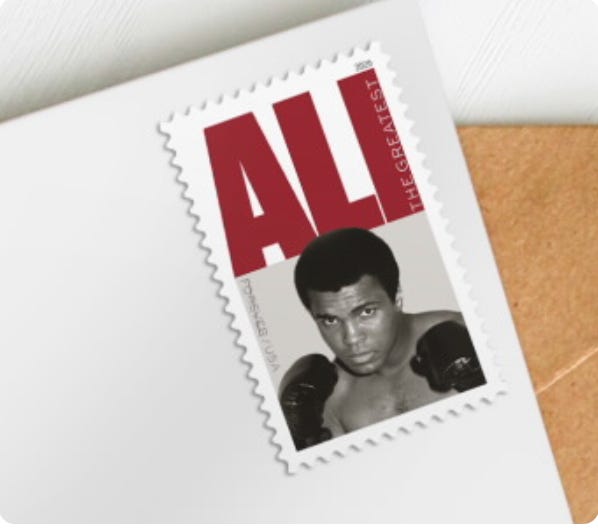
Many of the dominant memories of Muhammad Ali focus on his wit and his float-like-a-butterfly-sting-like-a-bee style as a boxer. For me, the release of a new postage stamp in his honor recalls a more vivid Ali memory: his refusal to be drafted during the war in Vietnam.
In 2015, as his three-decade battle with Parkinson’s continued to erode Ali’s health and diminish his ability to speak with his former ease, the Newsday sports desk asked me in my retirement years to write a column about that aspect of his life—an opinion version of a prepared obituary. I wrote it, and Newsday ran it months later, at the time of Ali’s death in 2016. It feels a bit weird to be quoting my own work, but I still stand by it. So, here is a section of what that column said, almost a decade ago:
Ali was not a university-educated student of history, not a heavily credentialed geopolitical theorist. But he saw with great clarity what so many of us missed: This was a war America had no business fighting.
Ali did not buy the “domino” theory: the idea that a communist victory in Vietnam would lead to the spread of communism in that whole region. It was, in fact, a civil war—one that the United States could never win. History has revealed that even President Lyndon Baines Johnson, who escalated the war drastically in 1964 and 1965—the year I accepted my own induction without a peep of protest—had serious doubts. He simply did not want to be seen as the president who lost Vietnam.….
In contrast, Ali made his own case in personal, vivid language. “I will not go 10,000 miles from here to help murder and kill another poor people simply to continue the domination of white slave masters over the darker people of the earth,” he said. No Vietnamese person had ever called him the N-word, he said, or enslaved him or tried to lynch him. So he declared himself a conscientious objector and refused to be drafted.
In the hyper-nationalist atmosphere of the conflict’s early years, the reviled villain was not Johnson, not Defense Secretary Robert S. McNamara. It wasn’t even Richard Nixon. No, the villain was Ali.
“I find nothing amusing or interesting or tolerable about this man,” influential producer David Susskind said on television. “He’s a disgrace to his country, his race and what he laughingly describes his profession. He is a convicted felon in the United States....He will inevitably go to prison, as well he should.”
Actually, Ali did not go to prison—unlike his religious leader, Elijah Muhammad, who rejected the draft during World War II and served four years in federal prison for urging his followers to do the same. The Supreme Court of the United States overturned Ali’s conviction while he was free on appeal. But he did endure three years of being barred from boxing, at the peak of his earning power. And he felt the string of broad criticism—even from Jackie Robinson, whose courage in the face of racism in baseball inspired Rev. Martin Luther King Jr. in his civil rights campaign, just as Ali’s courage in refusing to fight helped to inspire King’s opposition to war.
Not long after Ali’s ordeal, David Halberstam wrote a great book called The Best and the Brightest, examining the hubris and erroneous certainties that got America into Vietnam. The title referred to President John F. Kennedy’s advisers. But we now realize this: The best and the brightest of the Vietnam era was the man who refused to fight, Muhammad Ali.
Of course, the draft no longer exists. We still have a requirement that all males register as soon as they turn 18, so the government will have their names, in case it decides in some future war to reinstate the draft. Failure to register at 18 is a federal offense, but the Department of Justice has for years not prosecuted those who refuse to comply: There are simply too many. The law also requires those who have registered to let the government know when they move. But people move a lot these days, and letting the government know the new address doesn’t seem to be a high priority.
In other words, the government’s draft registration list is so full of holes that it is virtually useless. It has one other big problem: In 2019, a federal court ruled that the males-only registration requirement is unconstitutional. The Supreme Court declined to take sides in the appeal of that ruling, and Congress has failed to act on one of the two alternative solutions: change the law to require women as well as men to register, or shut down the Selective Service System that administers it.
In the absence of an actual draft, today’s young people do not face the stark choice that confronted Ali: join the military or go to prison. But there are plenty of good reasons not to join the all-volunteer armed forces. Of course, the always powerful reason not to enlist is this: You could end up bleeding to death in some far-away land, in a war you don’t understand and America can’t possibly win. Or you could come home missing a limb, suffering the nightmares and flashbacks that come with post-traumatic stress, or committing suicide. Now, in the second presidency of Donald Trump, there are other reasons: You could be dispatched to an American city, to put down an imaginary insurrection, or sent off to an insane, unnecessary, unwinnable conflict in a place like Greenland.
So my advice, as we near the tenth anniversary of Muhammad Ali’s death, is this: Buy a few sheets of the new Ali stamp. Use most of them in the coming months on whatever you are mailing. But keep at least one to put on a bulletin board or other prominent place in your home, to remind you of Ali’s insight and his courage during the war in Vietnam. And if you are of age to join the military, don’t.
But people are getting bad advice from adults who should know better. Today I read a piece in a weekly paper about a high school teacher who spent four days at a “Marine Corps Educator Workshop.” The story said that the teacher "found clear parallels between the Marines’ teachings and teaching students in high school.” Really? In his book, Hell, Healing and Resistance, Daniel Hallock reported this unlovely chant that marines used on their five-mile runs: “Rape the town and kill the people! That’s the thing we love to do! Rape the town and kill the people! That’s the only thing we do! Throw some napalm on the schoolhouse, watch the kiddies scream and shout!” I wrote an email to the teacher's principal. Pushing back against the alleged glamor and lory of the marines is not easy.
Given all the stuff I have been reading about ICE recruiting people, I don't expect them to be careful and concerned with the rights of either immigrants or US citizens who protest.